
PROFESSIONALLY EVIL EDUCATIONAL RESOURCE
Continuous Penetration Testing
Your environment doesn’t sit still for a year. Neither should your testing. This page is a guide to continuous penetration testing, including why the annual model is falling behind, and what an ongoing program looks like in practice.
What is Continuous Penetration Testing?
Continuous Pentesting is an always-on, ongoing pentesting practice that combines manual testing with automation. Instead of one point-in-time snapshot, you get a rolling picture of your risk. New vulnerability disclosures, new assets, new code deployments: each one gets surfaced and assessed as it appears, not twelve months from now.
Continuous penetration testing replaces the single annual engagement with ongoing testing tied to how your environment actually changes. It pairs automated vulnerability scanning, running on a regular basis, with a trained consultant reviewing and validating what comes back, rather than leaving you to interpret raw scanner output on your own.
Fill out the form to get more information on how Secure Ideas can help your organization with continuous penetration testing.

Get a Quote for Quality Continuous Pentesting
Fill out the form below and we’ll be in touch.
Great customer support, easy access to decision-makers, compelling services library, and excellent pricing!
Cyber Security Team Lead
Retail
Continuous vs. Annual Penetration Testing
A traditional, annual pentest is a snapshot. It tells you what your environment looked like on the days testing happened, and that snapshot starts going stale the moment the report is delivered.
On the other hand, continuous pentesting provides ongoing visibility into the service, telling you what your environment looks like now, with fresh documentation for each finding.
Here is how the two practices compare in some key areas:
| Annual Testing | Continuous Testing |
|---|---|
| CadenceOne test, once a year | Ongoing scanning combined with expert review on a regular cadence |
| VisibilityFindings remediated, then no visibility until next cycle | New vulnerabilities and assets surfaced as they appear |
| CoverageNew code, vendors, and infrastructure go untested for months | Testing can align to release cycles, not just the calendar |
| DocumentationA single point-in-time report for auditors or insurers | A running body of documentation, always current |
That said, neither approach makes the other obsolete. A deep, manual pentest still has a place, particularly for complex applications or specific compliance milestones. Continuous testing fills the space between those engagements so nothing goes unnoticed for ten months at a time.
Looking for focused security testing?
Schedule a free scoping call to discover your cybersecurity needs ›
How Continuous Testing Works
Unlike a traditional pentest, continuous testing isn’t a line from start to finish. It’s a loop that keeps running as your environment changes.

Automated scanning surfaces new risk, a consultant reviews and confirms what’s exploitable, findings are reported on a recurring basis, and retesting closes the loop, aligned to your release cycle rather than a fixed date on the calendar.
CONTINUOUS TESTING
See how PETaaS® supports continuous testing with flexible, credits-based penetration testing and built-in advisory services.
Why Annual Testing Is Falling Behind
Three main forces are pushing organizations away from the once-a-year model, and none of them are expected to reverse.
Regulations Are Getting More Specific
Multiple compliance frameworks used to treat an annual pentest as sufficient for security. That’s changing fast.
For example, PCI DSS has always required annual testing, but the current standard also calls for testing after any significant change to the cardholder data environment (CDE). For most merchants, this means testing is triggered several times a year, not once. GLBA went further: the FTC’s amended Safeguards Rule, which has been in force since June 2023, requires covered non-bank financial institutions to run annual pentests plus vulnerability assessments every six months, or to run continuous monitoring that achieves the same outcome. That “or continuous monitoring” clause is worth noting. Regulators are now writing ongoing testing directly into the compliance option, not just the audit-day checkbox.
HIPAA is trending the same direction, although it isn’t final yet. The US Department of Health and Human Services (HHS) proposed updates to the Security Rule in 2025 that would require vulnerability scanning at least every six months and pentesting at least annually for organizations handling electronic protected health information (ePHI), with a final rule expected sometime soon. Nothing is locked in until HHS publishes the final version, but the proposed direction is clear enough that healthcare organizations are already being advised to build the cadence now rather than wait for the compliance date to force it.
Underwriters Are Tightening Standards
Cyber insurance used to ask for a checkbox: has a pentest happened in the last year? However, that is no longer good enough for a lot of carriers. Claims volume has outpaced premiums for several years running, and underwriters have responded by asking for verifiable, current evidence that an organization is actively finding and addressing vulnerabilities, instead of a report that’s ten or eleven months stale by renewal time.
For higher-risk industries, that increasingly means semi-annual or quarterly testing as a condition of coverage, along with firm remediation windows attached to findings, often 30 to 60 days for anything rated High severity. If you miss the window, some carriers won’t renew at all. A single annual report doesn’t give an underwriter much to work with when they’re trying to price risk in real time, but a running body of documentation does.
Environments Move Faster Than a Yearly Test
The deeper issue is that most environments don’t look anything today like they did a year ago. If you’re deploying code daily, or even weekly, the system that a pentester examined in January has already been rebuilt multiple times over by the time that report lands on your desk. New features ship, third-party integrations get added, infrastructure moves to new providers, and every one of those changes is a chance to introduce something that a once-a-year test won’t catch until the next cycle.
All that means that an annual report is a description of infrastructure that no longer exists in the same form it was during testing. This doesn’t mean that the test was wrong, just that the environment kept moving after the test ended, and no tools or testers were watching it in the meantime.
Who Needs Continuous Testing?
Small and Medium Networks
You need coverage of a dedicated security function without the headcount to run one. Continuous pentesting could help close the gap between limited staff and network visibility.
Large or Complex Networks
You need scheduled, recurring assessments because they work better for you than one big annual push. Your team needs a consultant who knows your environment to catch issues earlier.
Regulated Industries
You have shifting regulatory priorities that you need to keep up with. Finance and banking (GLBA), healthcare (HIPAA), and payment processing (PCI DSS) are all moving toward requirements an annual test alone won’t satisfy.
Fast-Moving Development Teams
You need testing that tracks your release cycles, so that new features get reviewed before they ship, not months after. Your team needs a solution that keeps up with them.

An evaluation of your security program against the PCI Data Security Standard, covering PCI security assessments, self-assessment support, and advising on scope, applicability, and controls. You get direct access to a Qualified Security Assessor who speaks plainly and knows the standard inside and out.
Led by the “PCI Guy” himself – Jeff Man.
How Secure Ideas Approaches Continuous Testing
Beyond the Test
Building Continuous Resilience
Continuous penetration testing is one piece of a larger shift: away from treating security testing as an annual fire drill and toward building it into how your organization normally operates.
That shift doesn’t happen by scheduling more tests on the same old model. It requires ongoing scanning, expert review, real-time findings, and retesting already built into a single program, rather than pieced together engagement by engagement every time a new need comes up.
This is exactly what Secure Ideas’ PETaaS® (Professionally Evil Testing as a Service) is designed for. PETaaS® packages ongoing testing, real-time findings, insurance-ready documentation, and built-in retesting into a single program that scales with your release schedule and your budget.
If continuous testing is the philosophy, PETaaS® is the program that makes it real: a running, human-reviewed testing operation instead of a once-a-year event.

Continuous
Pentesting
Frequently
Asked
Questions
Have a question that isn’t answered here?
See our full FAQ page.
Is continuous testing more expensive than an annual pentest?
The overall cost depends on scope and cadence. Because continuous testing is scoped based on overall effort, and combined internal/external engagements are scoped together, costs for continuous testing are often more predictable over a year than a single large annual engagement plus any emergency retesting would be.
Does continuous testing replace manual penetration testing entirely?
No. Continuous testing fills the space between deeper, fully manual engagements. Complex applications and specific compliance milestones can still benefit from focused, manual testing. Continuous testing focuses on the changes to an app or environment over time, while annual testing can provide a deeper and more holistic view into the same assets.
How often does testing actually happen in a continuous pentesting cycle?
The cadence mostly depends on your industry, regulatory requirements, and how frequently your environment changes. During scoping, we build the testing cadencearound your risk profile, relevant regulations, and company requirements, not a fixed template.
Does this help with cyber insurance renewals?
Yes. Every test in a continuous pentesting cycle generates documentation that shows active, ongoing risk management, which is increasingly what carriers ask for at renewal.
What industries is continuous testing most relevant for?
Continuous testing is a direction that many industries with strict regulatory compliance requirements. For example, finance, healthcare, and payment processing all have testing requirements that are moving toward continuous or semi-annual cadences.
Additionally, fast-moving development teams outside regulated industries can benefit just as much from the coverage. Organizations that deploy code on a daily, weekly, or even monthly basis may find that the annual cadence does not provide enough visibility into their most sensitive assets.
Can we see a sample report from a Penetration Test?
Absolutely. Any reputable penetration testing company should provide sample reports upon request. Reports are your primary deliverable and should include an executive summary, testing narrative, detailed findings with risk ratings, replication steps for verification, and actionable remediation recommendations. Not all reports are created equal, so reviewing samples helps ensure the format and content meet your needs. Most companies will accommodate reasonable modifications to reporting formats.
What is Professionally Evil Testing as a Service (PETaaS®)?
PETaaS® is on-demand pentesting services, which provides you with continuous access to our penetration testing expertise rather than a one-time assessment. This approach offers on-demand or scheduled testing, which integrates with your software development lifecycle, and delivers regular vulnerability analysis with ongoing support. While it may initially appear more expensive than traditional testing, PETaaS® is significantly more cost-effective than hiring full-time security staff and provides proactive, real-time vulnerability identification.
Note: The industry lacks a standard definition for penetration testing as a service, so verify that your provider’s approach aligns with your expectations.
Continuous Penetration Testing
Continuous Pentesting keeps testing running instead of leaving your network exposed between annual checkups. We pair ongoing vulnerability scanning with a real consultant reviewing the results, and catching new risks as they appear across web apps, APIs, and IoT ecosystems. Regular reporting means you always know what’s new, what has changed, and where to point the roadmap next.
Security that doesn’t wait for next year’s test.
Threat-Led Penetration Testing
Threat-Led Pentesting simulates the specific tactics, techniques, and procedures of the threat actors most likely to target your organization, instead of following a generic playbook. We work with you to identify relevant adversaries and scenarios, then build a bespoke test around them. It’s the approach DORA now mandates for certain financial entities, and happens to be a strong fit for any mature security program.
Tested against the threats actually coming for you.

Purple Team Penetration Testing
Purple Team Pentesting engagements put our red team and your blue team on the same call, testing and defending in real time. As we run attacks, your team watches, tunes detection, and learns what an actual intrusion might look like on your systems. It’s a faster way to validate specific controls and walk away with sharper monitoring.
Your defenders, tested and trained at the same time.

Red Team Penetration Testing
Red Team Pentesting engagements go beyond finding vulnerabilities. Our consultants simulate a determined adversary, and chain together recon, phishing, and physical access attempts to show how far a real attacker could get and what they could walk away with. Most engagements wrap up in a month or less, with reporting delivered within a week.
See your whole attack surface the way an attacker does.

Ride Along Penetration Testing
Ride Along Pentesting embeds our consultants directly with your internal security team, working side-by-side instead of independently. Your team gets a front-row seat to our techniques and methodology, letting them pick up skills in real time as the engagement unfolds. It’s a hands-on way to level up your team while still getting a full assessment.
Testing that trains your team while it runs.

Time-Boxed Penetration Testing
Time-Boxed Pentesting focuses effort on your highest-priority assets within a set window, instead of trying to cover everything at once. It’s a strong fit for large environments, budget-conscious teams, or anyone just getting started with testing. We work to set the scope through a quick scoping call, so the timeframe fits your risk profile, instead of a generic template.
Focused coverage, built to fit your timeline.
Recognized authority and trusted guidance built on years of uncovering risks for organizations like yours.
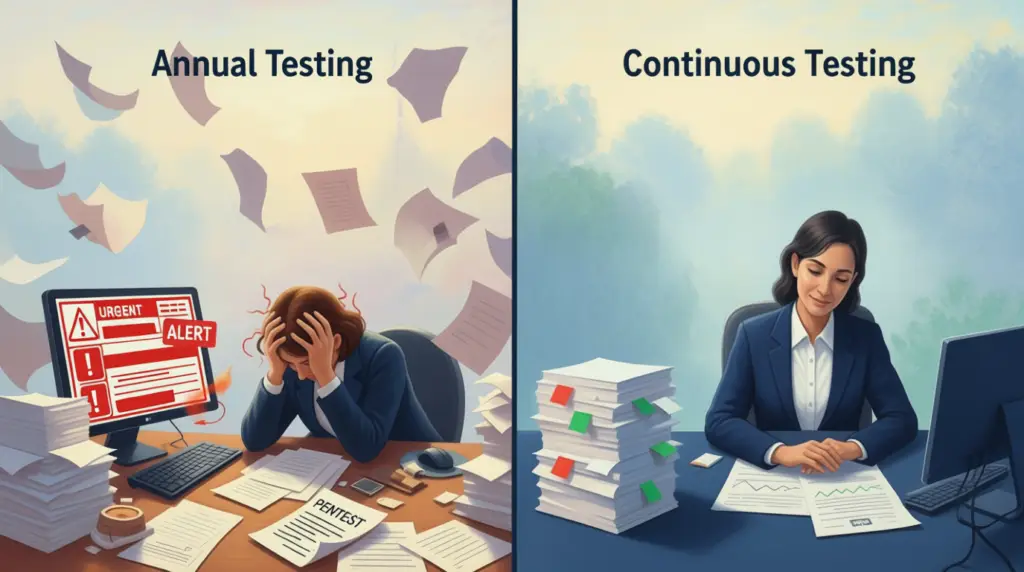
Once-a-year testing leaves a ten-month blind spot between engagements. We break down why PCI DSS, GLBA, and cyber insurance requirements are pushing organizations toward continuous testing instead of scrambling before renewal.

The GLBA Safeguards Rule requires financial institutions to maintain a full, documented information security program, not just an annual test. We walk through the specific requirements, from risk assessments to ongoing vulnerability and penetration testing.

Cyber insurance underwriters increasingly want proof you’re actively managing risk, not a compliance report from last year. See how flexible testing credits and continuous penetration testing can strengthen your position heading into renewal.